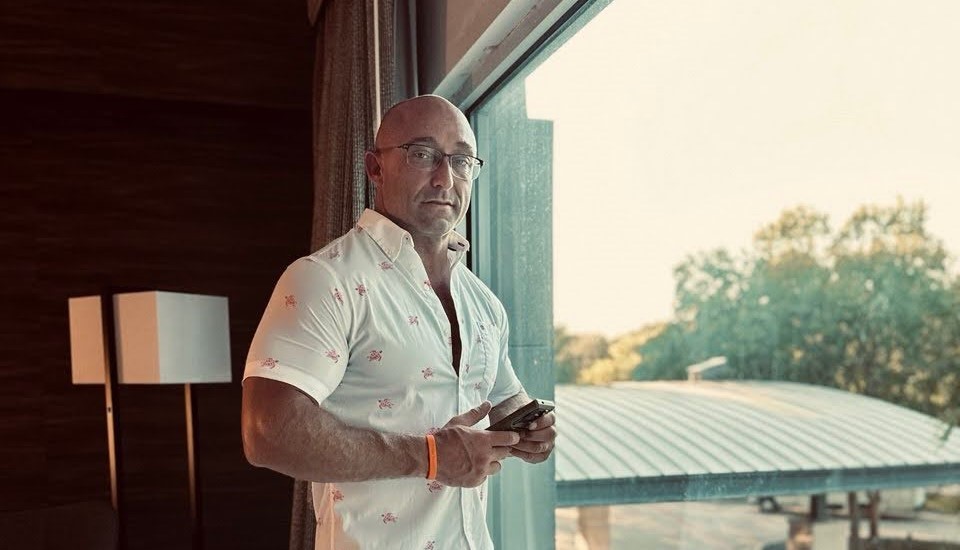

After years helping change criminal justice policy, the documentary storyteller and producer is building a new creative chapter around authorship, lived experience, and stories that resist easy conclusions.
Louis L. Reed spent years working to change laws. Somewhere along the way, he became increasingly interested in something legislation could not change on its own: the stories people believe about those affected by the laws.
Reed understands the distinction personally. He spent nearly 14 years in federal prison before building a career that eventually placed him inside some of the country’s most visible criminal justice reform efforts. But whether he was working on federal legislation, sitting across from policymakers or navigating national media attention, he kept encountering the same dynamic.
People with lived experience were frequently part of the story. They were not always part of deciding how that story was told.
“I’ve spent years fighting over what laws say,” Reed says. “Film made me interested in something just as powerful: who gets to decide what a person’s story means.”
That question is increasingly shaping Reed’s next chapter as a documentary storyteller and producer.
From Policy to Storytelling
Reed’s policy career includes work on more than 30 state and federal criminal justice measures, including the First Step Act of 2018.
He later served as Senior Director of Strategic Partnerships at REFORM Alliance, the criminal justice organization co-founded by Jay-Z, Robert Kraft, Michael Rubin, Meek Mill and other leaders across business, sports and entertainment. He previously held national leadership roles at Dream Corps Justice, working on sentencing, probation and parole, voting rights and reentry.
Those experiences put Reed at an unusual intersection of policy, culture and media. They also exposed him to the limitations of policy arguments.
Legislation often requires compressing complicated human experiences into numbers, outcomes and talking points. Storytelling can do the opposite. It can sit with contradictions.
For Reed, filmmaking became less about leaving advocacy behind than exploring something advocacy alone could not accomplish.
“A person can be more than one thing at the same time,” Reed says. “Some of the stories I’m most interested in are the ones where you can’t decide in the first five minutes who the hero is, who the villain is or what you’re supposed to think.”
Moving Behind the Camera
Reed’s path into entertainment developed gradually, first through projects where his own experience and policy work were part of the story and later through roles that gave him greater influence over how stories were constructed.
He appears in The First Step, the documentary following the political and human effort surrounding federal criminal justice reform and the passage of the First Step Act.
His role expanded significantly with When Does Freedom Begin?, now available on Prime Video, where Reed serves as both a co-producer and one of the documentary’s featured subjects.
The film follows Reed and two other formerly incarcerated men navigating life after prison and examines a deceptively difficult question: when does freedom actually begin?
For Reed, serving on both sides of the camera changed the experience.
Being a subject means trusting someone else to interpret your life. Producing means becoming responsible for the larger story, including how experiences other than your own are handled.
That distinction has become increasingly important to him.
Reed’s television work also brought that perspective into scripted entertainment. He worked as a consultant and creative consultant on Hulu’s UnPrisoned, starring Kerry Washington and Delroy Lindo, which explores the complicated family dynamics surrounding a father’s return from incarceration.
Authenticity in that setting was not simply about getting prison terminology right. Reed’s contribution drew from understanding the emotional details surrounding incarceration and release: family relationships that changed while someone was gone, expectations that do not match reality and the uncomfortable distance between being released and actually feeling free.
Beyond Criminal Justice
Reed does not want his storytelling work confined to incarceration.
His involvement with Holding Liat signals the broader direction.
Reed serves as a strategic advisor connected to the documentary, which follows an Israeli-American family after Liat Beinin is taken hostage during the October 7 attacks. The film was shortlisted for the 2026 Academy Award for Best Documentary Feature.
On the surface, Holding Liat and When Does Freedom Begin? occupy entirely different worlds. That is partly the point.
What interests Reed is not simply criminal justice. It is what happens when filmmakers enter people’s lives during moments of enormous complexity and assume responsibility for translating those experiences to an audience.
That requires more than access.
It requires judgment about what to show, what context an audience needs, whose perspective receives authority and whether a story is being simplified because simplicity makes it easier to consume.
Those questions travel across subject matter.
Lived Experience Is More Than a Seat in Front of the Camera
Reed has become particularly interested in the difference between representation and authorship.
Film and television have increasingly recognized the value of lived experience. Reed believes the next question is how much influence people with that experience actually have.
Bringing someone into a room after the fundamental story has already been decided is different from allowing that person to challenge the assumptions underneath the story.
That philosophy informs Decoded: Story Lab, the platform Reed is developing around documentary and narrative storytelling.
The idea is not that only people who have lived an experience are qualified to tell stories about it. Reed’s argument is more nuanced: proximity can reveal things that research alone may miss, and the strongest creative process knows how to use both.
“Lived experience shouldn’t be decoration,” Reed says. “If you bring somebody into the room because they know something you don’t know, you also have to be willing to hear them when what they tell you complicates the story you thought you were making.”
That principle also reflects Reed’s own history.
For years, institutions had extraordinary power to define him through a conviction, sentence and federal identification number. Later, journalists, advocates and filmmakers encountered different versions of that same life.
Moving into production has allowed Reed to think differently about authorship, including who possesses it and who traditionally has not.
Building a Broader Creative Future
Reed is now looking toward projects across documentary, scripted entertainment and other forms of nonfiction storytelling.
He wants to work with filmmakers, studios and creative partners on stories where his combination of lived experience, policy knowledge, cultural access and story judgment can add something difficult to reproduce through research alone.
He also wants Decoded: Story Lab to create pathways for people with lived experience to participate throughout production as producers, advisors, writers and creative decision-makers, rather than appearing only when a camera needs someone to tell a personal story.
But Reed is equally resistant to replacing negative stereotypes with overly polished redemption narratives.
Some lives do not resolve cleanly. People make contradictory choices. Institutions can help and harm simultaneously. Someone can deserve accountability without having the worst thing they have done become the entirety of who they are.
Those are the spaces Reed increasingly wants to explore.
His trajectory from federal prison to national policy work to film could easily be packaged as its own redemption story. Reed appears more interested in what comes after that headline.
For years, his work centered on changing what systems were permitted to do to people.
Film has given him a different question to pursue: who gets to determine what those people’s lives mean once their stories reach the rest of us?
The medium has changed. The question of who gets to define the story has not.
Written in partnership with Tom White